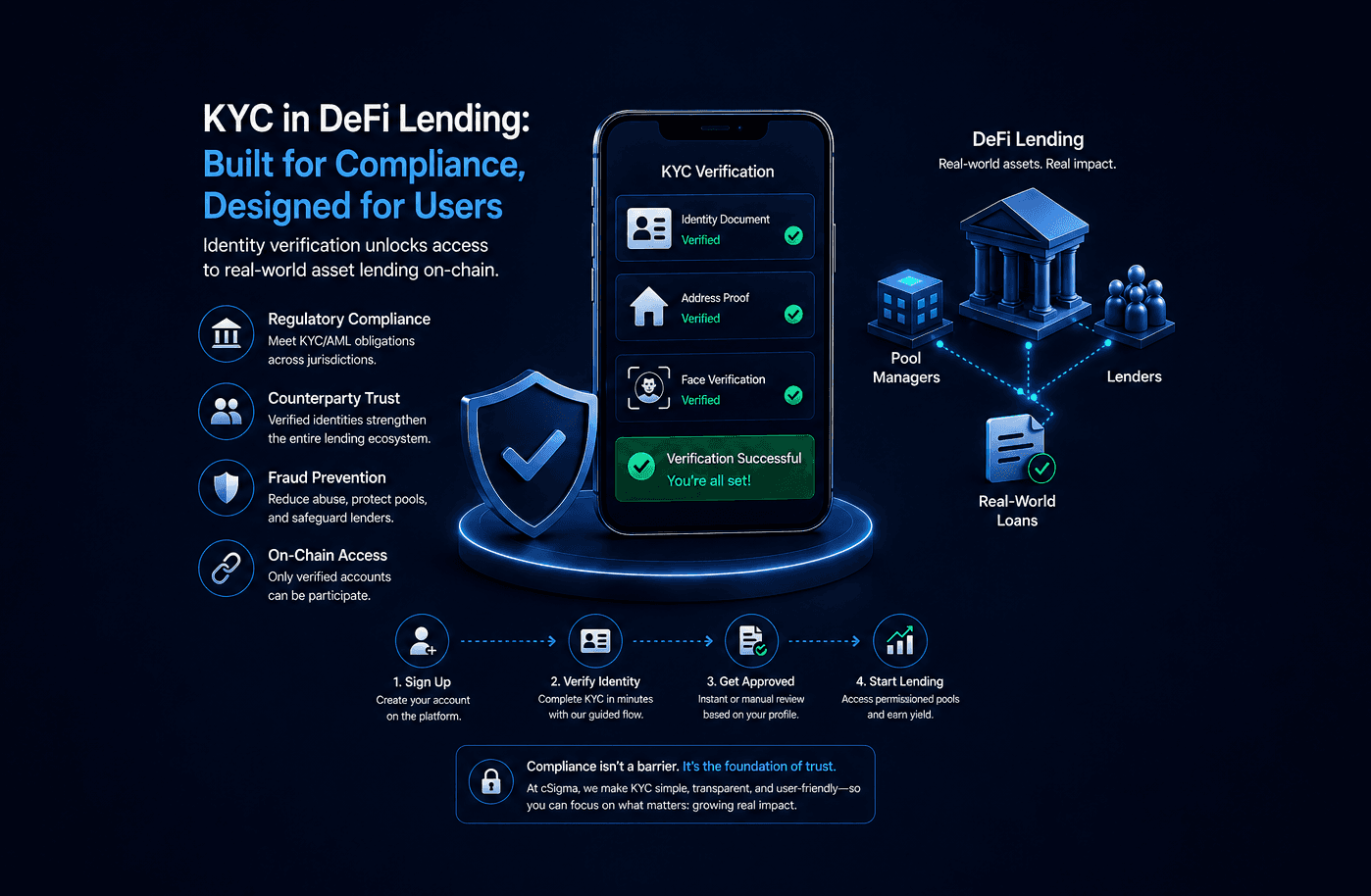
As DeFi expands into real-world asset lending -where actual loans, legal agreements, and regulated capital are involved - one question becomes unavoidable: who is on the other side of this transaction? That's where KYC (Know Your Customer) comes in. For many platforms, KYC is an afterthought - a clunky form, a long wait, and a frustrating experience. At cSigma, we built it differently. Here's why identity verification is essential, and how we keep the experience smooth without cutting corners.
Why Open Access Doesn't Work for Real-World Lending?
Traditional DeFi lets anyone with a wallet lend or borrow - no questions asked. That works for overcollateralized crypto loans where smart contracts handle everything.
It falls apart for real-world asset lending, where:
Legal relationships matter- lender rights need to be enforced in real courts
Regulations apply- AML/KYC laws govern investment funds across jurisdictions
Fraud is a real risk- anonymous actors can exploit yield at the expense of other lenders
Every serious RWA platform has introduced gated access. cSigma is no different — but the how matters.
Why KYC is Non-Negotiable?
Regulatory reality- The EU's Anti-Money Laundering Directives, the US Bank Secrecy Act, and FATF guidelines all require lending facilities to verify investor identities. When lenders deposit into pools holding real loan agreements, they're investing in a financial product. Regulators care who's doing that.
Counterparty trust- Pool managers deploy lender capital to real-world borrowers. Verified identities strengthen every link in that trust chain. A pseudonymous lender who disappears is a legal nightmare when it's time to enforce a promissory note.
Fraud prevention- Without verification, one bad actor can create dozens of accounts to manipulate pool statistics or exploit withdrawal windows. Verified identity is the first line of defense.
On-chain access control- On cSigma, KYC isn't just a checkbox. Only accounts belonging to verified users can be whitelisted on the smart contract. An unverified account simply cannot deposit into a pool — identity verification unlocks blockchain access.
Two Tracks: KYC for Individuals, KYB for Institutions
Not everyone goes through the same process.
Individual lenders (accredited investors) → automated KYC- a guided, real-time identity check that takes under five minutes with an instant result
Institutional lenders & Pool Managers → KYB (Know Your Business)- manual document upload reviewed by our team before granting access
The reasoning- automated verification handles passports and face matching well. It can't evaluate complex corporate structures with multiple beneficial owners across jurisdictions. Those need human judgment.
How Automated KYC Works?
Verification happens inside a secure session directly within the cSigma platform — users never leave the app. Three checks run in a single session:
Identity Document- Government-issued ID card or driving license, matched against registration details
Address Proof- Bank statement, credit card statement, or ID card with address, verified using fuzzy matching (so "St." vs "Street" doesn't cause a failure)
Face Verification- Liveness check confirming the person is real and present, with duplicate detection to prevent the same person registering twice
No tab-switching, no email attachments, no printing. Every outcome is handled . After the session, there are no silent failures or dead ends:
Outcome | What the User Sees | What Happens Next |
Accepted | Redirect to the congratulations screen | Account becomes active; wallet can be whitelisted |
Declined | Declined due to inconsistent documents. Try again! | Retry after a brief pause |
Cancelled | Process was cancelled. Was it a mistake? | Retry immediately |
Limit Reached | Maximum attempts exceeded" + support contact + upload option | Switch to manual upload |
Error | Error screen with manual upload option | Switch to manual upload |
Feedback timing is intentional - cancellations show a retry prompt after 2 seconds; declines wait 5 seconds so users can read what went wrong first.
The Retry System: Firm but Fair
Users get up to 5 automated attempts. The cap exists to prevent bot abuse and protect resources - but it's designed to be fair:
Network errors don't count- connectivity issues don't burn an attempt
Technical errors don't count- a problem on our side doesn't penalize the user
There's always an exit- at the limit, users can contact our team or switch to manual document upload
No legitimate user gets permanently locked out.
Manual Upload: Always an Option
Manual document upload is available at every point - not just when limits are hit. For institutional users, it's the primary path.
The form adapts by user type:
Individuals → personal ID and proof of address
Institutions → company registration, beneficial ownership, and business credentials
Every submission requires a self-declaration checkbox: "I affirm that the documents provided are accurate and truthful." This creates a timestamped acknowledgment - small, but legally meaningful.
The Pending State: No Guessing
After submission, users enter a pending state. Rather than leaving them confused, we show exactly where they stand:
"Verification Incomplete"- Started but didn't finish? Clear prompt with a button to continue.
"Waiting for Approval"- Documents submitted, team is reviewing. Realistic expectations set, support email provided.
Once approved, users are automatically redirected to the platform. No one gets stuck on a status page.
What's Next?
Real-time status notifications- push-based updates when pending verification resolves, instead of manual check-backs
Smarter document guidance- showing the most accepted document types for a user's country before they start, reducing first-attempt failures
Wallet management- smooth access control updates when verified users add new wallet addresses, without re-verification